

How To Repair Green Giant Arbortvaewhen It Is Blend ?
Introduction
There are many evergreen trees to choose from for the garden, but 1 of the most useful is the Arborvitae, or Thuja. These soft-leaved, upright copse grow in a wide range of climates and soil conditions. They make excellent specimens and are amid the very all-time trees available for making hedges and screens, a vital and bones office of nigh any garden. So basic are these trees to many gardens that information technology is hard to imagine a world without them.
Although there are but a few wild types of Arborvitae, they are very widely grown in gardens around the world and well-known to many gardeners, who rely on them for the basic construction of their garden. Every bit an evergreen screen they work 365 days a twelvemonth, and so they e'er give good value. There are hundreds of unlike forms, varying enormously in size and shape and including some of the best fast-growing copse for hedges, such as Thuja Green Giant, a remarkable tree that is always top of the list for screening and hedging plants.
The name Arborvitae comes from the Latin phrase 'arbor vitae', which means 'tree of life'. This proper name was ordinarily given to several evergreen trees that did not 'dice' during winter but remained constantly alive and green. It is that permanence that makes them so highly-seasoned in the garden, since they give a stable groundwork to the seasonal changes of the other copse and flowers in the garden. An alternative business relationship of this name is that the early settlers found Native Americans making tea from the twigs and leaves, which was a valuable source of Vitamin C during the winter months. West Coast Native Americans telephone call it 'long-life maker' and eastern Native Americans may have used a similar name, leading to settlers calling it the 'tree of life'.
The name Thuja is the one preferred by botanists and professional gardeners, since information technology is the Latin proper noun given by them by the keen botanist Carl Linnaeus (or Carl von Linné). He was a Swedish botanist who lived in the 18th century and devised a system of organizing and naming plants to aid international botanists discuss them accurately. Thuja was the name he gave to 1 of the plants in this group, and information technology is still their name today. The name is used both as a common proper noun and as a scientific name. When meant scientifically it is written in italics.
What Practice Thuja Look Similar?
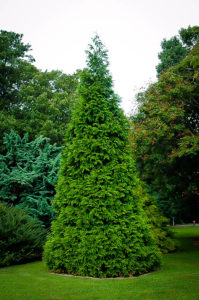 Thuja plants are part of the big group of plants called conifers. These are the trees that have cones, not flowers, and normally have narrow green needles, not sparse, broad leaves and flowers similar nearly other plants. Almost all are evergreen and they are often found in colder regions of the globe. Although commonly called 'evergreens', at that place are besides evergreen flowering trees, then that name tin exist confusing.
There are only six species of Thuja and all of them are trees of varying sizes, usually upright and conical in shape when mature. The bark is dark-brown and stringy, often shedding in strips.
They have needles that are not similar those of, for instance, pines, sticking out from the stalk. They are flattened and pressed confronting the stems, overlapping each other and making fan-similar sprays of green foliage. Younger foliage protrudes a lilliputian from the stems and has a spine on the end of the leaf. We can assume that this is to give the young seedlings some protection from grazing animals until they get tall enough for acme to requite them protection. Older trees rarely if ever show this feature, making them soft and pleasant to the impact.
Since these are conifers they exercise not have flowers, but produce cones. These form at the end of the stems and so they are often not seen much on trimmed plants. There are split up male and female person cones. Both types are pocket-sized, made up of a tiny cluster of 8-12 scales and are single, not in groups. These cones expect like tiny buds. The male cones produce pollen which is blown by the wind to the female cones. The female person cones develop into small, round seed cones which are about ¼ inch across. These are commonly green and leathery, but in the Oriental Arborvitae (T. orientalis) they are difficult and woody, with a pronounced spine on each scale [1] . After the cones open up and the seeds are released the cones of all kinds of Thuja go brown.
Thuja in the Garden and Landscape
Thuja or Arborvitae plays a big role in the garden, with the taller kinds making wonderful hedges that clip into dense screens or they can be left unclipped to brand more than informal barriers. Planted alone or in small groups they are first-class accent specimens around the firm, in lawns or in shrub beds. They tin exist used to frame a doorway or entrance, outline a driveway or stand up as dramatic solitary specimens. The many unusual forms, with colored or exotically-formed foliage and in many sizes, can be used every bit interesting specimens likewise, in beds, rock gardens or gravel-covered areas. Thuja can also be grown in containers of various sizes and used on terraces and decks as vertical or rounded accents that demand very little attending to e'er wait good.
As Screens:
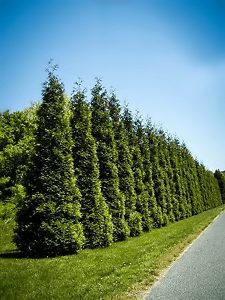 Thuja copse make great screening plants. They are naturally dumbo, upright and lush green all-year-round. They need little or no clipping to maintain an attractive form and can be planted as a screen and left to develop naturally. They shortly reach 20 or 30 feet in elevation, creating a solid barrier that filters wind, noise and pollution and gives complete privacy.
Particularly important for this role is Thuja Green Behemothic, which has a rapid growth-charge per unit, perfect leafage all year round and a dumbo class. Since information technology volition abound three feet a year when immature, information technology rapidly fills in and gains height, making an fantabulous screen very quickly. Information technology can abound unclipped upwardly to sixty feet, so it makes the perfect tall screen besides, although with clipping it can be kept at any peak.
For smaller gardens, especially in colder areas, Thuja Emerald Green is an fantabulous shorter screen, chop-chop growing to around 12 feet tall.
Every bit Hedges:
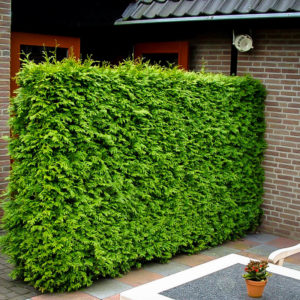 Thuja trees also make corking hedges because they take well to clipping and shearing, and so they tin can be turned into formal hedges easily. They quickly fill-in and go solid and dense, making the perfect properties to all kinds of garden designs and styles. If clipped from an early on stage they can be equally short as 2 feet, or every bit alpine as 30 feet or even more. By choosing the right variety, a perfect hedge for any climate can be easily grown to virtually any size and form. For larger hedges Thuja Green Giant is the outstanding and premier choice, while for smaller hedges in libation areas Thuja Emerald Green is perfect.
As Accent Specimens:
Thuja do not of course accept to be grown in rows, and as single specimens or groups they make beautiful accent plants in the foundation planting effectually a house or in shrub beds. With a wide variety of forms available, from upright to rounded, and in green or gilt leafage, there is lots of variety to choose from. Evergreens requite stability to the garden and a permanence that other plants lack. Since they can exist trimmed, controlling size is like shooting fish in a barrel, and then they tin can be used to frame a door, make full a corner, abound beneath windows and occupy lots of places in the garden where they volition exist right at home.
As Container Plants:
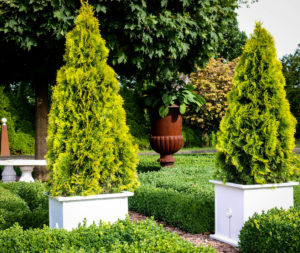 As well as growing in the garden, Thuja make perfect low-maintenance container plants. A matched pair in large pots makes a welcoming entrance feature, or they can be placed around a terrace or patio. Although all types can be grown in pots, the dwarf varieties are normally the ones called, since they volition live for many years without out-growing the container and they volition need little or no clipping.
The History of Thuja
The proper noun Thuja was used several hundred years before the birth of Christ past the Greek Theophrastus, a disciple of Aristotle. He is oft called 'the Male parent of Botany' and wrote a book called Historia Plantarum (Enquiry into Plants), in which he used Thuja to proper name a tree from Morocco a niggling similar a Cypress.
In the 1530's plants and seeds of the White Cedar, T. occidentalis, besides called the American Arborvitae, were introduced into France from the colony of Quebec [ii] . Seeing a similarity, botanists of the fourth dimension called it a Thuja, spelling information technology 'Thuya', which is anyway how it should be pronounced. In his earlier works Linnaeus used that spelling, simply by the time he brought out his major work Species Plantarum (1753), the official start-engagement for all institute names, he spelt it 'Thuja', so that is how it is named and spelt today.
The Oriental Arborvitae, T. orientalis, was introduced into Holland from Prc and Japan and it was being grown in Kingdom of the netherlands early on in the 18th century. Later French missionaries in China sent seeds to Paris, and from at that place information technology was introduced past Philip Miller to England effectually 1740. It was named by Linnaeus a few years afterward. It was re-introduced from Japan by the plant collector Robert Fortune in 18612.
Western Red Cedar, T. plicata, was discovered at the end of the eighteenth century in Nootka Sound, on the west coast of Canada, by a Spanish expedition of discovery led by Alessandro Malaspina and José de Bustamante y Guerra. Information technology was introduced into Britain and Scotland from Oregon in the early 1850'south.
The Japanese Arborvitae, T. standishii, was discovered in cultivation in People's republic of china and Nippon past Robert Fortune and introduced into Britain in 1860. It may accept been brought to America from Britain, but seeds must certainly have come directly from Japan to the Due west Coast, probably with Japanese immigrants.
The Sichuan Arborvitae, T. sutchuenensis, was starting time discovered in 1892 in Mainland china[iii].
The Korean Arborvitae, T. koraiensis, was discovered and described in 1919 by the Japanese botanist Takenoshin Nakai.
The Species and Varieties of Thuja
Although in that location are just a handful of species of Thuja, their discovery is a mini-history of botanical expeditions and institute discovery around the world. Most accept been adult in cultivation to produce hundreds of special forms, officially called 'cultivars', although here we will often use the word 'variety' for them every bit well.
Thuja occidentalis, White Cedar or American Arborvitae
This was the start species of Thuja known in Europe, and 1 of the very outset N American plants grown there. A seedling was brought back to France by the explorer Jacque Cartier in 1536 and grown in the gardens of the King of France. Strangely, this plant grows much better in the colder parts of North America than it does in most of Europe, where information technology is not highly regarded.
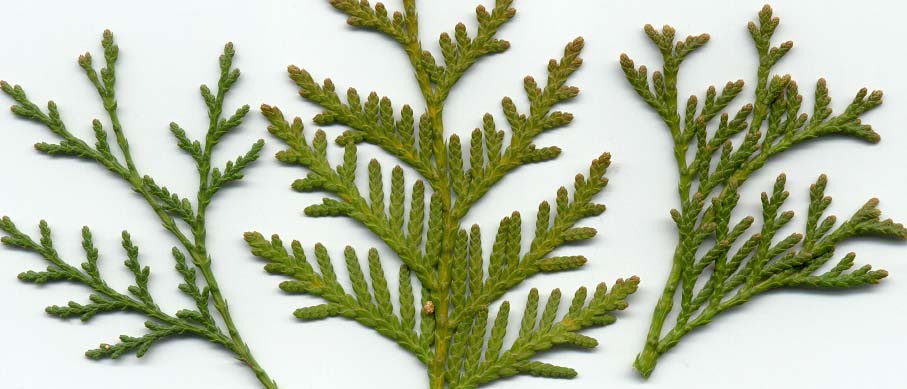
White Cedar grows naturally from the Canadian Province of Manitoba east around the Great Lakes and into Québec, Prince Edward Island, New Brunswick, and Nova Scotia. It occurs in the states of Vermont, New Hampshire and Maine, too every bit in isolated pockets in, Connecticut, Kentucky, Maryland, Massachusetts, North Carolina, Ohio, Pennsylvania, Tennessee, Virginia, and West Virginia.
It is establish growing especially in swampy areas and wetlands, where other more-vigorous species of trees find information technology hard to consummate, as well in rocky areas and cliffs for the same reason. However the largest trees grow on better-tuckered state.
Although White Cedar can grow very tall, most trees seen in cultivation are around xxx feet in height, rarely to 60 feet, with a trunk diameter close to the basis of 24 to 36 inches. The tallest tree currently known is growing on S Manitou Isle, Michigan and is 112 feet tall with a trunk bore at basis level of 69 inches. The tips of the branches are flattened and the underside is stake greenish. The cones are about 1/3 of an inch long, ellipsoidal in shape, fabricated up of eight or ten scales.
White Cedar is hardy to zone 2, so it volition survive winters of minus 50 degrees, and information technology does well all the way into zone seven, making information technology the hedging plant of selection for colder states. Although inexpensive wild plants are sometimes sold for hedging, it is difficult to produce a very dense hedge with such plants and varieties such every bit 'Emerald Green' are a much better choice.
Garden Varieties of White Cedar
There are literally hundreds of varieties of White Cedar which accept been produced by gardeners and constitute breeders in Due north America and Europe. The main variations are in: leaf color, ofttimes aureate xanthous; leaf shape, from thread-like to fan-like or crested; course, with rounded forms beingness very common, as well as narrow, upright forms; and overall size, with many dwarf forms suitable for rock gardens.
Some well-known varieties of special value are:
'Emerald Green':This is a form that is denser, smaller and narrower than wild plants, making it an ideal choice for a specimen that does not need clipping, or for a dense hedge. The foliage is a rich, vivid-green, without the yellowish color that is often seen in wild plants. It was originally a bulb selected in Denmark around 1950 and at first it was called 'Smaragd' but this proper name was abandoned later it was introduced into Northward America and replaced with 'Emerald Green' because of the foliage color.
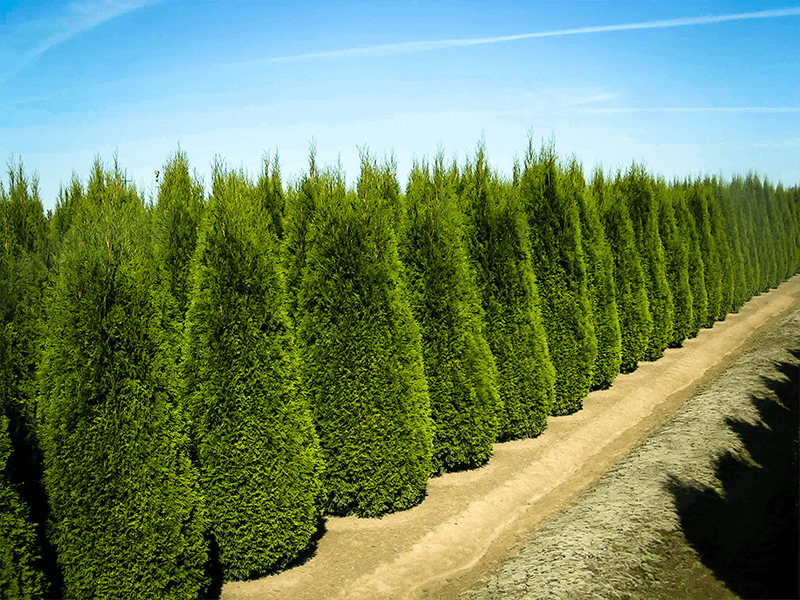
This constitute is an ideal option for hedging in the coldest areas, since its dumbo growth makes it possible to practice much less clipping to develop a strong hedge. The rich dark color is kept all winter and there is ordinarily no winter burn, unless the hedge is exposed to salt-spray. It likewise makes an excellent specimen plant, framing a doorway or as an accent in shrub beds.
'Hetz'southward Midget': of the many round or world forms of White Cedar, this is probably the best, forming a perfect green mound 3 anxiety alpine and wide. It was developed in the start half of the 20th century by Frank C. Hetz, who owned a nursery in Pennsylvania. It grows well in sun and partial-shade, is pest free, just as hardy as its bigger brothers and fits perfectly into plantings effectually the house, or as an easy globe for a planter or container.
'Danica': this globe form was introduced in 1969 from a bulb, once again grown in Denmark. It is very small and slow-growing, eventually forming a perfect world a footling less than 2 feet alpine and across. The foliage is carried in vertical sprays, rather than horizontally, every bit it normal for White Cedar.
'Golden Earth': This is another pop globe form, rather larger, reaching about 4 anxiety tall and across, eventually up to 8 feet subsequently 70 years. The foliage, peculiarly when new in the bound, is a bright gilded-yellow color. It was introduced in 1946 and is a golden mutation of an old American variety called 'Woodwardii', whose exact origin is non known.
'Holmstrup': is some other Danish choice similar in many ways to Emerald Green, merely denser, more pyramidal and smaller, so it is ideal for a specimen, but
a little too dense to make a flat-fronted hedge – the plants will not grow together well.
Thuja plicata, Western Redcedar
When we move to the west coast we find White Cedar replaced by the Western Redcedar, Thuja plicata, also known as Western Arborvitae, the 2d species of Thuja native to North American.
This tree grows naturally in Oregon, Washington Country and over the border in British Columbia, In nature it is a very large tree, toping 200 anxiety, with trunks upward to thirteen anxiety in diameter, just in cultivation information technology is much smaller, usually growing a little over fifty feet alpine, or rarely to lxx feet, and with a spread of 15 to 25 feet. When grown as a specimen it keeps the branches low to the ground for very many years, just when crowded together, unless clipped, the lower branches are lost, giving a alpine trunk covered with fibrous reddish-brownish bark that has a strong and pleasant aroma. It lives for many centuries; the oldest tree known being near 1,500 years onetime.
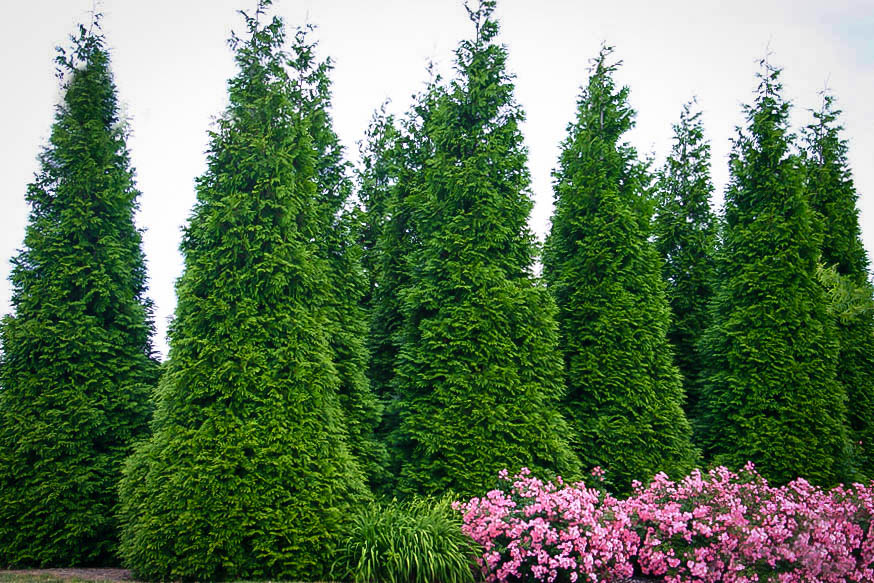
The tree has typical Thuja leafage merely at that place are whitish bands on the underside of the leaves, distinguishing it from White Cedar. When crushed the leafage releases an attractive aroma. The cones are about ½ inch long when mature, with about 14 scales.
The woods is widely used for outdoor construction and furniture, since the woods of mature trees contains a natural preservative, thujaplicin, which acts every bit a fungicide and prevents disuse for up to 100 years. For this reason the forest, which is quite soft and easily worked, is favored for boat-building, roof shingles and garden construction, since it volition not rot. Untreated information technology weathers to an bonny soft-grey color with pronounced grain. About 5% of people are strongly allergic to the dust produced by cut and working Western Redcedar.
Western Redcedar grows best in libation, but not cold areas, and then it is not as hardy every bit White Cedar, but thrives in moister areas in zones five to 7. Information technology is not drought resistant and prefers damp soil. It is oft institute in the wild growing in wet areas. It is unusual in beingness quite shade-tolerant, especially when young, pregnant that trees tin can be successfully planted in shady areas and allowed to grow up into the sun. Western Redcedar is a fast-growing tree, growing faster than spruce in many cases. As a forestry tree it tin be ready to harvest in as little as 50 years, although stands are best left for 100 years.
In the garden it can be grown both as a specimen, as a hedge or as a more than natural screen. It does best in damper parts of the Westward Coast, where spectacular specimens tin can be seen, or in cooler parts of the due east. In hotter areas the hybrid 'Greenish Behemothic' is a much better choice.
There are some garden varieties (cultivars) of Western Redcedar that have been produced and may sometimes be available:
'Excelsa': this fast-growing tree forms an upright column with short horizontal branches and glossy, nighttime-green foliage. Developed in Germany it is suitable as a hedging plant.
'Fastigiata': this narrow upright form has dense foliage and makes an attractive specimen for express infinite, every bit well as a hedge that needs much less clipping. The variety 'Hogan' is similar.
'Hillieri': a tiresome-growing bush with crowded branches and leaves in irregular whorls. Reaching just eight to 10 feet, this form was developed in England by the famous Hillier's Plant nursery around 1900.
There are a number of dwarf forms with gilt foliage, including 'Rogersii', 'Stoneham Gold' and 'Zebrina'. The terminal, besides known every bit 'Zabrian', has, every bit its proper name suggests, alternating bands of yellow and more dark-green leafage, giving an overall yellow-green appearance to the bush-league.
Thuja orientalis, the Oriental Arborvitae
The remaining species of Thuja all occur in the Far E, first with the Oriental Arborvitae. This plant is now more than correctly known as Platycladus orientalis, a genus containing just this plant, distinguishing information technology from Thuja on the basis of differences in the female cone and also in the seeds lacking the 'wings' seen in other Thuja species[4]. Although this name was kickoff proposed in 1949, gardeners are ho-hum to prefer name changes and information technology is still called Thuja in many gardening works and catalogues.
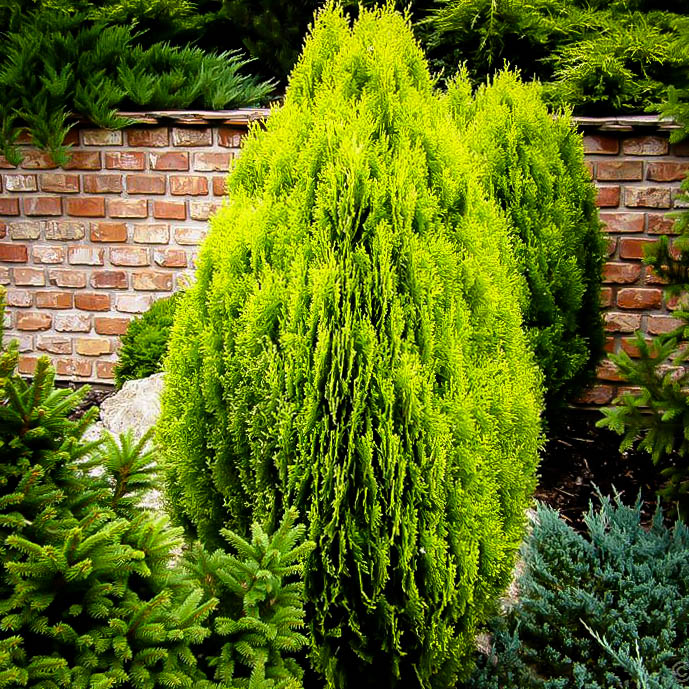 The Oriental Arborvitae occurs naturally from the N-east of Islamic republic of iran, through China, upwardly into eastern Russian federation and the Korean peninsula. The original natural distribution has been blurred past extensive planting of this tree in the past over a wide area. This includes planting forth the ancient Silk Route through Central Asia. Information technology has also been so extensively planted in Japan that it has become part of the natural forests. It has been suggested that it may merely be genuinely wild in Islamic republic of iran2.
It forms a big shrub or small tree 30 to forty feet alpine in cultivation, although over 60 feet in the wild. The torso is two feet or sometimes more in diameter. Copse tin live for i,000 years and the tallest tree, found in Tajikistan, is 115 feet alpine. In gardens it is often seen equally a dense, rounded and fat-conical tree with many stems, looking more shrub-similar. It is one of the best choices for xeriscaping or planting in any dry area.
It is distinctive from other Arborvitae in having the branches and their fans of leaves held in a vertical position, rather than the common more horizontal position of other Thuja. They are the same color of greenish on both sides with no white bands. The roundish, egg-shaped cones are up to1 inch long and blue-green in color, with a grayish waxy coating making them wait purplish. The scales of the cones are distinctively thick and woody, with a hooked, horn-like protrusion at the top. The seeds are wingless. It is for these differences with other Arborvitae that they have been re-named Platycladus.
The Oriental Arborvitae likewise differs in its soil requirements, preferring well-drained and fifty-fifty sandy conditions, thriving in drier stony soils, even alkaline ones. This makes it a swell garden selection as an evergreen shrub or tree for drier regions or quick-draining soils in wetter ones. It besides prefers warmer temperatures, doing best in zones 6 to 11, making it the natural pick in more than southerly and western states. Information technology is drought-tolerant when established and although non common salt tolerant it will even abound on crushed –coral and shell soils of coastal areas. It is also very resistant to near all pests and diseases.
Over 40 cultivars exist, but nearly are rare in gardens. Some common garden varieties include:
'Aurea': grows 12 to 18 anxiety alpine with yellow leaf.
'Aurea Nana': this dwarf form has golden-yellow leaf and reaches v feet alpine in near 10 years. It has an upright, rounded form, showing clearly the vertical branches of the species. Information technology is less wintertime-hardy and does better in shade than the original species and may also be less drought-resistant.
'Elegantissima': this tight, upright wide-conical course in a yellowish-green colour can attain 15 to twenty feet tall. It was developed and released in 1958 by a British nursery. The foliage turns more greenish in summer and bronzy in winter.
'Filiformis Erecta': (also known as forma flagelliformis) has drooping sprays of foliage which are cord-like and in clusters. It is oft seen in People's republic of china and Japan in gardens every bit a novelty. It grows just 5 to 6 feet tall.
'Sunkist': is a tiny green shrub-form growing just 24 inches tall and wide.
Thuja standishii, the Japanese Arborvitae
On the Japanese Islands of Honshu and Shikoku, higher in the mountains, natural stands of the Japanese Arborvitae can exist found. Likewise, this tree is widely grown as a crop in Japan, where it is valued for its waterproof and softly-scented wood. This forest is used for sake barrels and cups and to build Shinto temples.
It forms a tree nigh 60 feet tall, sometimes reaching 100 feet, with a slender trunk no more than than three feet across. This tree closely resembles the Western Redcedar, although there are recognizable differences betwixt the cones. Information technology forms a much more open up tree than the other Thuja trees.
There are no item cultivated forms of this tree and the tree is in fact very little grown exterior Japan, although it is hardy to zone vi, just it is ane of the parents of the of import hybrid, Thuja Green Giant.
Thuja sutchuenensis, the Sichuan Arborvitae
While many Thujas are mutual in the wild and also widely cultivated, often in many forms, this found is an endangered species that is not in normal cultivation at all. It was discovered by the French missionary and institute collector, Paul Guillaume Farges in 1892 in Sichuan, Western People's republic of china. Information technology was harvested locally for its highly-valued scented forest. For the next 100 years information technology was never seen and it was assumed to have been wiped out by over-cutting. It became the only conifer officially declared extinct. Even so in 1999 it was rediscovered near the spot Farges had originally found it, on some very inaccessible slopes of the mountains[5].
The area has been designated a Special Protection Area to preserve these few remaining trees. Despite its scarcity and protected status, prayer chaplet claiming to be made from the scented wood of this tree can be found for sale on the cyberspace.
This species forms a tree or large shrub between 30 and 65 anxiety tall, with a slim 12 inch trunk. It has white markings on the underside of the leaf similar to Thuja plicata, but the leaves and cones are smaller than other Thujas, which distinguishes this species from them.
Thuja koraiensis, the Korean Arborvitae
This is a 2nd rare and endangered species very rare in cultivation. It occurs in mountainous regions of Korea, chiefly today in the South, since it is threatened by North Korean government policies of forest immigration of slopes for agriculture. Only a very small number of mature specimens are believed to be yet growing in the North[half dozen]. It forms a modest tree, 10 to 30 feet tall, with sprays of foliage. This tree makes an interesting garden plant, since the underside of the leaves are almost pure white, with broad bright-white bands, giving the tree an attractive and unusual advent. Winter hardy to zones 5 or half dozen, this tree could become much more than common in gardens.
| Species | Branches | Branchlets | Upper leaves of shoots | Cones | ||||||
| On the leader | On the branchlets | |||||||||
| vertical aeroplane | horizontal airplane | Both sides green | White bands beneath | With oil glands | Without oil glands | Furrowed | Not furrowed | Thick and woody | Pocket-sized and leathery | |
| T. orientalis | X | Ten | X | Ten | X | |||||
| T. sutchuenensis | X | X | X | X | Ten | |||||
| T. occidentalis | X | X | X | X | X | |||||
| T. plicata | X | 10 | 10 | 10 | X | |||||
| T. standishii | X | Ten | X | X | 10 | |||||
| T. koraiensis | X | X | Ten | X | X | |||||
Table 1 – Identification features of Thuja species[7]
Hybrid Thuja
When different only related trees abound in different parts of the globe, of course there is no chance of them 'meeting up' and producing seeds. However when we cultivate together copse that are brought from different continents, breeding together is something that can and does happen, either naturally or with the help of plant breeders.
I of the pregnant consequences of the coming together of two species is that when they cross together the strengths of each mask the weaknesses of the other, producing trees that are stronger, hardier, faster-growing and more than vigorous than either of the parent trees. Plant breeders call this 'hybrid vigor' and information technology is an important and valuable effect of plant breeding.
There exists just i Thuja hybrid, but this boggling plant changed completely the garden utilize and importance of these plants. Before its evolution, Thuja was important in cold areas and also of involvement for some of the unusual and attractive forms that had been developed. But it hardy merited the enormous attention from near gardeners that now centers on this constitute, making it 1 of the biggest selling garden plants in the nursery industry and the center-piece of many garden plans. This establish is called Thuja 'Green Giant'.
Thuja 'Green Giant'
The story of this jolly greenish giant is long and complex[eight]. It begins in a nursery in Kingdom of denmark in 1937. This was D.T. Poulsens Planteskole og Frøhandel, founded by Dorus Theus Poulsen, a gardener and botanist built-in in 1850 in Frijsenborg, Denmark[9]. In 1878 Poulsen started a plant nursery with his two sons, which before long became the most famous and prestigious nursery in Denmark. The family unit began to breed roses, their hybrid Polyantha roses became famous and they were the predecessors of today'due south Floribunda roses. The family presently had several nurseries across Denmark. D.T. Poulsen himself died in 1925, but his sons continued his piece of work, convenance and hybridizing many unlike plants. In 1937 they spotted an interesting found, which they thought was a hybrid Thuja. It is not clear if this had occurred naturally or by deliberate crossing of the parent trees.
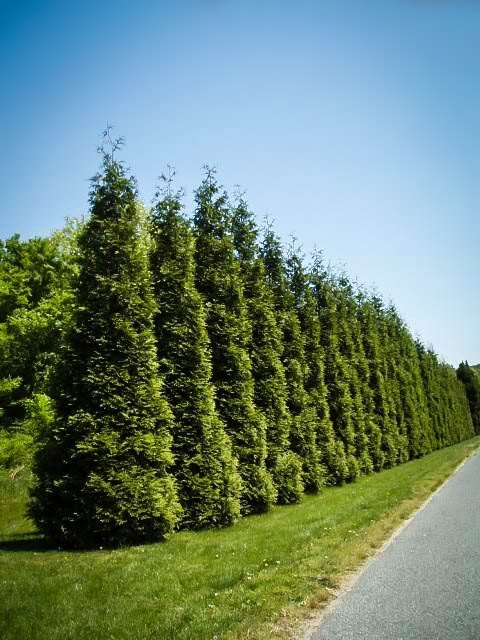 Equally happened right across Europe at this time, World War Two stopped all activity and prevented the exchange and movement of new plants both in and out of all European countries. And then it was non until 1967, thirty years after, that some immature plants came to the National Arboretum in Washington D.C. from the Poulsen nursery in Kvistgaard, Denmark. Actually several different plants were brought over, and they became confused, so that when i of them had grown to thirty feet tall by the mid-90s and was alluring excited interest from experts, it was no longer clear exactly which of the original plants it was.
3 scientists undertook to solve this puzzle; Susan Martin, from the National Arboretum; Kim Trip, from the New York Botanic Garden; and Robert Marquard, from the Holden Arboretum in Ohio. Later all-encompassing searching through records and carrying out DNA assay, they not but identified which original Poulsen constitute this was, but demonstrated that is was indeed a hybrid, between Thuja standishii and Thuja plicata, the Japanese Arborvitae and the Western Redcedarviii.
This cantankerous-pacific meeting, taking place in a field in Denmark, gave the gardening world a new treasure, a hardy evergreen with blemish-gratis rich-greenish foliage, extremely rapid growth, a svelte and dense upright form and the power to grow in a wide range of soils and climatic conditions. This was 'hybrid vigor' spelled out big.
A search for a suitable name was settled when a nurseryman from Tennessee, Don Shadow, suggested 'Greenish Giant'[ten]. I nursery in detail took an involvement in that unmarried specimen standing in the grounds of the National Arboretum. Wayland Gardens had begun in the 1920s when two European nurserymen got together in Ohio and started a successful nursery business. Following the deaths of its founders the nursery was bought in 1975 past Park Seed Company, who moved the whole business to South Carolina. There information technology flourished and became one of America's biggest nurseries, introducing many new plants to gardeners.
As the last century came to a close, Wayland Gardens propagated hundreds of plants of Thuja Green Giant from that original establish, and began to promote and publicize information technology. By 2004 information technology became the biggest selling item in their catalogue. The timing was perfect; with many mature gardens in the south-due east needing old, diseased hedges removed and replaced, which meant that literally millions of plants had to exist grown so that there could exist new, perfect hedges right across the land[xi].
Choosing the Right Thuja
Hardiness Zone
Because of their natural distribution over large parts of the world, dissimilar Thuja grow in lots of unlike climates, and then no matter where y'all live, at that place is a suitable type for your climate and growing conditions. Depending on your growing zone, different species and types will do best:
| USDA Hardiness Zone | Suitable Thuja | |||
| White Cedar | Thuja Hybrid | Western Redcedar | Oriental Arborvitae | |
| Zone 2 | Thuja Emerald Green | |||
| Zone 3 | Thuja Emerald Light-green | |||
| Zone 4 | Thuja Emerald Green | |||
| Zone 5 | Thuja Emerald Greenish | Thuja Green Giant | Western Redcedar | |
| Zone 6 | Thuja Emerald Green | Thuja Greenish Giant | Western Redcedar | Oriental Arborvitae |
| Zone 7 | Thuja Emerald Green | Thuja Green Giant | Western Redcedar | Oriental Arborvitae |
| Zone viii | Oriental Arborvitae | |||
| Zone 9 | Oriental Arborvitae | |||
| Zone 10 | Oriental Arborvitae | |||
Rainfall and Drought-resistance
White Cedar and Western Redcedar prefer areas with significant rainfall and a more humid atmosphere. This is especially true for Western Redcedar, which does not exercise well in drier areas. Thuja Dark-green Behemothic is more drought-resistant than either of these species, making it the ideal choice, even for drier parts of zones 5, 6 and 7.
In warmer, drier areas the Oriental Arborvitae is virtually suitable, growing well throughout the Southward-west and South-due east. This is one of the best shrubs for dry out locations, or where no watering is possible.
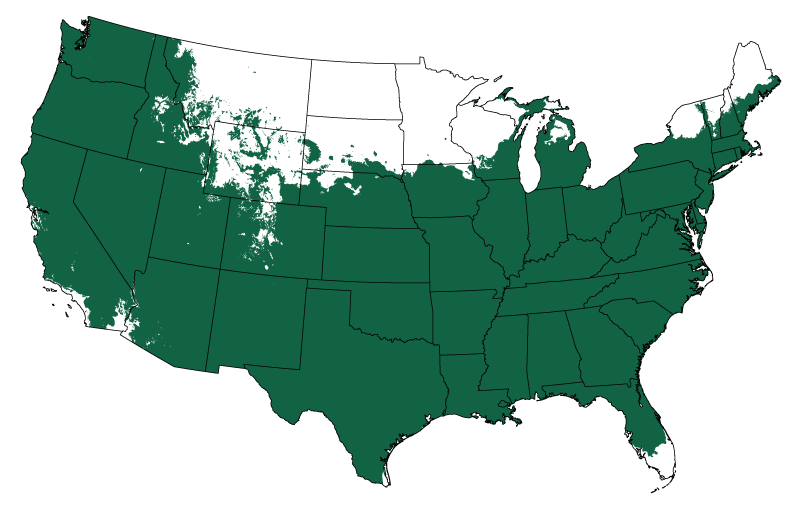
Calorie-free and Shade
Since nigh Thuja live below larger wood trees, most are able to tolerate some shade and will abound well with total sun for merely l% of the day. The more sunlight, the denser the growth will exist, which is a cistron to consider when installing hedges and screens. Of class, regular clipping can assist compensate for more open growth by stimulating denser branching.
Every bit a general rule Thuja trees will do best in total sun, but all except the Oriental Arborvitae will grow well in partial shade. Then when choosing a variety, if you alive in a zone where there are choices, of the near commonly grown plants, Thuja Emerald Green and other White Cedars accept the best shade tolerance, followed by Thuja Green Giant and then Western Redcedar. Oriental Arborvitae should be grown in full sun.
Soil Types
Thuja are tolerant of virtually types of soil, but do all-time in ones that agree a good amount of water. Peculiarly when young and growing vigorously, they benefit from a good, regular supply of water, just not from being in soil that is constantly flooded. As already mentioned, Oriental Arborvitae is very drought-resistant and prefers dry, sandy or fifty-fifty stony soils.
Thuja will grow well in acidic, neutral and slightly alkali metal soil, so adjusting the pH is not normally necessary. A proficient amount of organic material added to the soil when planting and as mulch each year for the early on years, volition ensure proficient dumbo growth in virtually any soil.
Choosing a Planting Location
Spacing
When planting your Thuja in rows or groups it is important to infinite them correctly. If they are besides close they will non develop well, merely if they are likewise far autonomously they may take years to meet, or even always stay slightly separated. The ideal spacing will allow the plants to grow, nonetheless mean that in a few years they will form a unmarried mass of plants.
For a screen, there are two methods of spacing and planting used:
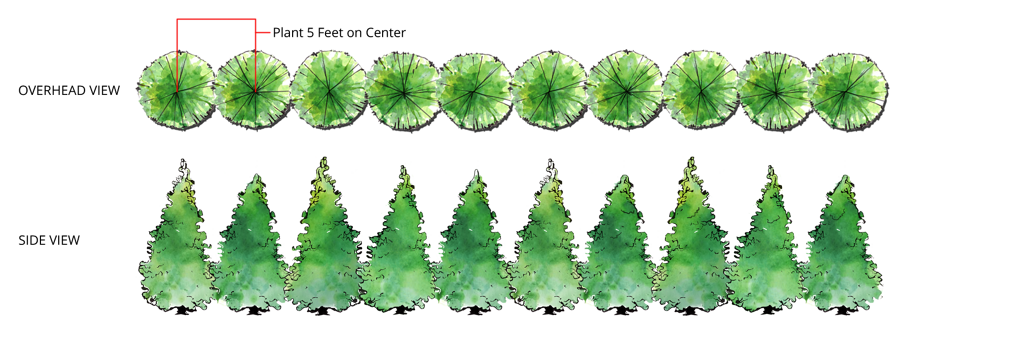
- Unmarried row: this is the most obvious method and for a shorter hedge plants should exist placed three to 6 feet apart, depending on their final size and your needs. If your screen or hedge is against a edifice, plant 6 feet from the wall, to protect the foundations. If you are planting confronting a fence, institute 3 feet from the contend so that the lower office of the plants remains bushy and the hedge remains on your side of the property line. Utilize the wider spacing given here for vigorous plants similar Thuja Green Giant, and the smaller spacing for others like Thuja Emerald Green.
- For a shorter hedge, less than 8 anxiety tall, found 3 feet apart.
- For a larger hedge or screen, institute four to 6 feet apart.
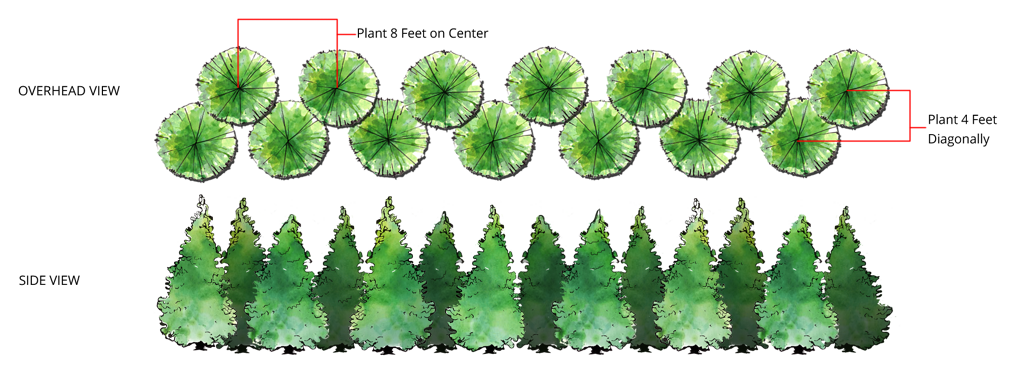
- Double row: This method will give a quicker screen and use slightly fewer plants for the density of screen created. Brand a double row, allowing 3-four feet between the rows. Space the plants 6 to 10 feet. Stagger the plants then each i is in the space of the other row. This method will requite a practiced dense screen in a short time.
Single Row Spacing for Thuja Green Giant Privacy Screen
Double Row Spacing for Thuja Green Giant Privacy Screen
To calculate how many plants you need for a screen, first mensurate the distance. So decide on the spacing. Split up the distance by the spacing and round-upwards to the adjacent number if the answer is a fraction. For a double row multiply this number past 2. Remember that the get-go institute will exist placed half the spacing distance from the end of the row, and the concluding constitute will be placed in the same mode. Place these plants first and so balance out the remaining plants in-between at fifty-fifty distances.
Recall that whatever spacing you use information technology is important to go along everything at the same distance and place the copse very evenly spaced. Employ a measuring tape to become everything laid-out earlier planting. The extra work will be worth it when you see the perfect screen yous have created.
Note: If you lot want your screen right to the ground it is important to start trimming early in the life of your screen. Although Thuja are better than many other plants at retaining their foliage closer to the ground, if y'all let the plants grow untrimmed until they are the height you want they volition exist sparse lower down and may not give you the screening you are trying to develop.
For a Specimen accept the width given for your tree, add together it to the last widths of the nearest other trees or shrubs and divide past ii. Found the trees at that distance apart. That way your garden will not become overgrown and crowded, forcing you to constantly prune and prune your plants.
Planting in groups is a smashing fashion to piece of work with Thuja copse when used as specimens. E'er plant your shrubs using odd numbers, 3, five, 7, 9, eleven, etc. This volition give your planting a more natural await. Await at the width you item tree will reach and space your plants at about 75% of that. In a few years they will have grown together into an bonny group.
Planting Thuja
It is worth taking a little endeavor to requite Thuja copse a good start in life. Once the planting positions have been decided, dig over the area, going downwards to the full depth of a spade and turning the soil over while removing weeds and their roots. Don't worry about taking out stones unless they are bigger than your clenched fist. Add some organic material to the soil to encourage root development. This could be garden compost, well-rotted manure or rotted leaves. If you don't have these materials, and so some peat-moss can exist used instead and that is readily available everywhere. Mix a big bucket of this organic cloth into the soil of the planting area of each tree.
When planting hedges it is often easier to dig a trench along the line, rather than individual holes. This makes it easier to infinite the plants correctly and conform them to get a perfectly fifty-fifty and straight row.
The night before planting, give the potted trees a heavy watering. Dig a hole 2 or 3 times the width of the pot, but only to the same depth equally the pot. Once you have dug your hole, add soil if necessary and printing with your foot in the bottom of the hole to brand certain the soil is house underneath the plant. Thuja should be planted at the same depth in the ground every bit they were in the pot – do not bury the lower foliage, or go out part of the root-ball exposed above ground.
Place the plant in the pigsty and put back most three-quarters of the soil. Using the feet, firm the soil downwards effectually the roots, so that there are no air-pockets in the soil and so that the tree is held firmly and can't shift around. Fill the hole to the pinnacle with h2o and wait for it all to drain abroad. When all the h2o has gone, supervene upon the rest of the soil and make everything level and groovy. No more water needs to be added, unless the surrounding soil is very dry. Mulch the roots with a thick layer of organic mulch. This should be 2-3 inches thick and completely cover the root zone and a little further out. Keep the mulch off the foliage and trunk of the tree. The mulch will reduce weeds, conserve water and keep the soil libation during the hottest conditions.
Y'all practice not need to apply a stake on your tree, in fact that is a bad thought, rather like giving a child a walking stick – your plant will be stronger and tougher without existence held up artificially.
During the showtime growing flavor water your plants deeply at to the lowest degree one time a week, and twice a week during hot, dry weather. Leaving a hose running slowly nigh the base of the found is better than spraying water onto the soil – you disturb the soil less and the water volition have a chance to penetrate securely effectually the roots. For hedges and screens installing a trickle hose along the base of the hedge makes watering much easier. This tin can be left in place as the hedge grows and so that it can be used during dry spells in future years.
Growing Thuja varieties in Planters and Containers
Thuja, especially the smaller varieties similar Thuja Hetz's Midget and Thuja Golden World, make good, low-maintenance, permanent specimen plants for pots and planter boxes. Choose a pot virtually twice the bore of the pot your tree arrives in and you lot volition not demand to re-pot for several years at least. Make sure the pot has drainage holes – drill one if necessary in the base. Exercise not stand the container in a saucer, but allow it drain freely. Remember that terracotta and clay pots demand more than watering than plastic pots. Clay pots should exist soaked in water for a few hours before using them.
Use potting compost designed for outdoor planters, not garden soil. Cover the drain hole with a couple of stones and fill the container with some potting compost to identify the institute so that the meridian of the root-ball is i inch below the top of the pot. Fill up effectually the root-brawl until the acme of it is reached and cover it with just a small amount of the compost. Make certain there is about one inch of infinite left free at the top to concord the h2o when you lot h2o your constitute. Firm down around the found only a little, do not press down hard. Water the tree thoroughly after planting, until water flows out of the bleed hole.
Water whenever you see the top layer of the compost has go dry. Use a liquid fertilizer for evergreens regularly during the growing season.
Caring for Thuja Trees
Ane of the great things nearly Thuja copse is that they don't need much intendance. Thuja Greenish Giant in particular is i of the near low-maintenance plants available. However a footling seasonal care will give the best possible results and make sure that your trees grow vigorously, await lush and green and remain healthy.
Fertilizer
Each leap add a layer of mulch over the roots of your plant. This should exist 3 inches deep and should extend out beyond the line of the foliage, simply not touch the trunk of your tree. Use something organic like garden compost or rotted leaves rather than bark or stones, which will not add whatsoever nutrients to the soil. Old mulch from previous years tin be removed if it is woody and hard, but otherwise it can just be covered with the new mulch.
When your plants are young, some fertilizer is helpful to encourage them to abound vigorously and get well-established. Employ a fertilizer designed for evergreen trees. This will requite a good supply of the nitrogen these copse need to proceed them healthy and deep light-green.
When they are young a liquid fertilizer is best, simply for mature plants a granular fertilizer is more than suitable and information technology should exist practical in jump. This should be sprinkled over the root zone and can be place over mulch likewise. Evergreen fertilizer has a lot of nitrogen in it, so look for something with a loftier get-go number, like 20-10-10. A light sprinkle of fertilizer over the whole root-zone is all that is needed and yous should avoid heavy fertilizing. This zone extends well-nigh ii feet further out from the plant than the spread of the foliage. Keep fertilizer away from the torso. If you want to abound your Thuja trees organically, products like soya-bean meal, cotton wool-seed repast or alfalfa pellets are suitable, although usually rich mulch will be all that is needed.
Trimming and Shearing Thuja Trees
All the different kinds of Thuja tin can exist grown without any clipping and they will go attractive plants and make dense screens. A niggling clipping in belatedly summer of young plants will help to brand them denser subsequently in life.
However if you desire to trim your screen or hedge regularly, for looks or to keep it smaller, so this should brainstorm during the first year. Do not wait until the trees reach the desired height and then start clipping. Worse, do not wait until they become also large and and so try to cut them dorsum difficult. Thuja will not re-sprout from blank branches, so it cannot be lopped and trimmed as many deciduous copse can be. When clipping or trimming, you should always leave some foliage in the clipped area, every bit blank branches volition never sprout new leaves.
Begin clipping lightly as soon as the plants are established. Always trim and so that the upper office is a piffling narrower than at ground level. In other words, the sides should slope inwards slightly. This but need be by a few degrees, only if there is no inward slope the lower branches will go thin over time and then become blank and may somewhen die. Because the upper growth will always be more vigorous, this means trimming more from the upper part of the plants than the lower part. Many new gardeners make the mistake of taking the same amount off all over the plant, resulting in hedges that bulge out towards the superlative, causing the lower parts to thin and die over fourth dimension..
The best times for trimming Thuja hedges and screens are late spring, early summer and early to mid-fall. Avoid trimming during hot and dry out weather, particularly with White Cedar hedges. In mild areas hedges tin can besides exist trimmed in winter, but be conscientious not to trim Thuja hedges in belatedly fall or winter if you lot alive in common cold areas with periods of severe freezing weather in winter.
Utilize gas or electric hedge shears, or mitt clippers, for your hedge. Practise not apply coarse cut machinery like chain saws (aye, some people do!). Cutting branches so they grow horizontally and practice not endeavour to 'tuck in' shoots, or exit long shoots growing upwards on the outside, or your hedge will fall apart easily, especially under snowfall.
Pests and Diseases
Thuja trees are tough, hardy copse that practice non take serious bug, just there are a few things to watch for. All Thuja are eaten by deer. If low-maintenance is your goal, thenThuja Light-green Behemothic is especially pest and disease resistant, making it the platonic selection for almost any area.
Potential problems for White Cedar[12]
Spider Mites: these minute relatives of spiders are sometimes institute, especially in hot, dry conditions. They are too small to exist seen hands, but cause a yellowing or 'bronzing' of the leaf. Sometimes fine webbing can also be seen, indicating a heavy infestation. Spraying the plants regularly with water during dry weather ordinarily prevents them from becoming a problem, or insecticidal soap will usually impale them.
Cedar Leafminers This tiny moth has caterpillars that alive inside the leaves, turning them yellow or brownish. It only lives on the young tips, and so information technology is rarely seen in clipped plants, but sometimes information technology is seen in unclipped ones. If rare serious infections occur, systemic insecticides give good control.
Shoot blight: this fungus is simply seen on weak plants, causing the stems to brown and dice. Plants that are well-watered and fertilized volition commonly not endure from this problem.
Winter Dieback: the foliage can turn brown in jump and die if your plants lack water during the winter. E'er soak the basis under your cedar copse in late fall if you live in a very cold expanse. Similar harm can be caused past salt used for winter de-icing.
Potential Issues for Western Redcedar and other Thuja[xiii]
Cypress bark beetle: this tiny beetle burrows beneath the bawl, causing twigs and branches to die. Information technology is normally only seen on weak and dry out trees, so keep copse well-watered and fertilized to prevent this pest.
Scale Insects: these insects alive under a hard beat out and await like bumps on the bark or leaves. Small amounts are not a problem and larger infestations can be treated with systemic insecticides.
Bagworms: these insects, which eat the leaves, make numberless of web and twigs, which hang from the branches like Christmas decorations. Large quantities tin cause significant leaf-loss. The organic sprays Spinosad and BT requite good control if applied in May.
Herpes fungus: This disease tin can cause branches and even whole trees to dice. There is no control, merely trees that are well cared-for rarely suffer from this problem.
Notation : Thuja Green Giant is nearly always free of pests and diseases, so it is a vastly superior selection from zone 5 and on into warmer areas.
| Pests and Diseases of Thuja | ||
| Symptoms | Cause | Handling |
| Yellow and bronze foliage | Spider mites | Water jet or insecticidal soap |
| Yellow and brown shoot tips | Cedar leafminer | Clipping or systemic insecticide spray |
| Dead leafage in jump | Winter dryness or salt spray | Deep watering before winter |
| Brown bumps on stems and leaves | Calibration Insects | Systemic insecticide if severe |
| Small bags of web and twigs hanging on branches | Bagworms | Spinosad or BT sprays |
[i] Transmission of Cultivated Conifers, Krüssman, G., Timber Press 1972/1985 translation (by Epp, One thousand.E.)
[2] Trees and Shrubs Hardy in the British Isles, Bean, West.J. (1914-1975) on-line edition
[iii] American Conifer Society, http://conifersociety.org/conifers/conifer/thuja/sutchuenensis/
[four] Mabberley's Found-Book, Mabberley, D.J., 3rd Ed. Cambridge University Printing.
[5] Thuja sutchuenensis: A rediscovered species of the Cupressaceae. (2002). Xiang, Q.; Fajon, A.; Li, Z.; Fu, Fifty.; Liu, Z. Botanical Periodical of the Linnean Guild 139 (3): 305–310.
[half dozen] Thuja koraiensis Kim, Y.-S., Chang, C.-S., Lee, H. & Gardner, Yard. 2022. The IUCN Cerise Listing of Threatened Species.
[7] Modified from: Transmission of Cultivated Conifers, Krüssman, 1000., Timber Printing 1972/1985 ( translation: Epp, M.Eastward.)
[8] Thuja 'Greenish Giant', the US National Arboretum. http://world wide web.usna.usda.gov/Newintro/grgiant.pdf
[9] D.T. Poulsen, Dansk Biografisk Leksikon. http://www.denstoredanske.dk/Dansk_Biografisk_Leksikon/Landbrug,_skovbrug_og_gartneri/Gartner/D.T._Poulsen
[10]Green Giant Arborvitae, past Gerald Klingaman. University of Arkansas, Sectionalization of Agronomics .http://www.uaex.edu/yard-garden/resource-library/plant-week/green-giant-arborvitae-i-27-06.aspx
[11] Critics of the constitute-patent organisation are quick to signal out that Thuja Green Giant was released by the National Arboretum patent-gratuitous. This meant that whatever nursery could propagate and grow it, making information technology possible to go on upwardly with the extraordinary demand for this institute.
[12]Pests and Diseases of the Eastern White Cedar. Pest Diagnostic Clinic, University of Guelph, Ontario, Canada http://www.guelphlabservices.com/files/PDC/006Eastern%20White%20Cedar.pdf
[13] Arborvitae Problems, Horticulture Middle, Cornell University http://ccenassau.org/resource/arborvitae-issues

How To Repair Green Giant Arbortvaewhen It Is Blend ?,
Source: https://www.thetreecenter.com/thuja-green-giant-guide/
Posted by: carverdoely1938.blogspot.com
0 Response to "How To Repair Green Giant Arbortvaewhen It Is Blend ?"
Post a Comment